
The New York Times Energy for Tomorrow Conference took place this week, and one of the speakers was Steven Chu, our Nobel-prize winning Secretary of Energy.
Dr. Chu told a tale that reinforces the idea that “environmental imperatives” can drive technological change to happen — and swiftly accelerate the process. Speaking before his New York City audience, Dr. Chu pointed out that before the automobile, people and their goods were moved around New York City by approximately 160,000 horses. As he put it, “There was a very visible environmental impact that was piling up on corners all over the place. So it hastened the shift remarkably.” It took only 25 years, give or take, for automobiles to replace horses and horse-drawn carriages. (You can hear Dr. Chu’s full presentation, and others from the conference, here.)
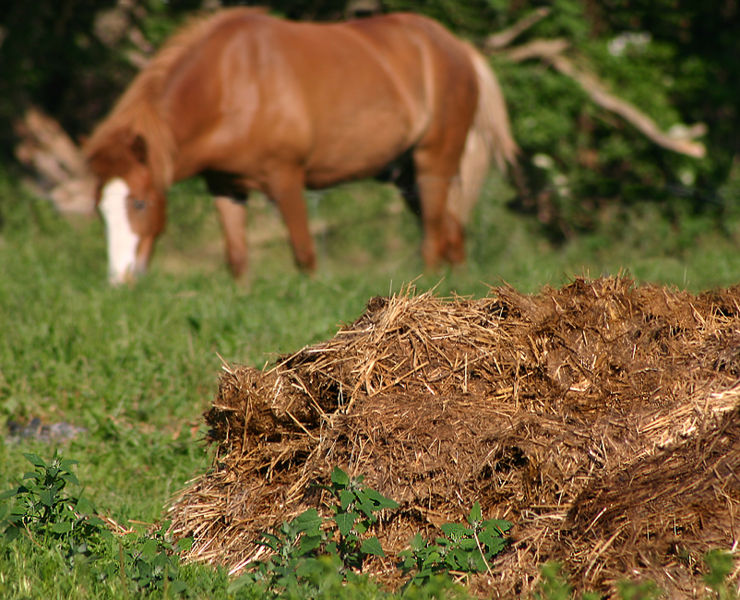
Manure in a field in Denmark, photo by Malene Thyssen
With gas prices back up over $4 a gallon, and my compost piles overflowing, and while large farms pay to haul manure offsite or leave it in those dreadful lagoons, one wonders how long it will take for someone, somewhere, to figure out how to make manure work for us as a fuel source. It’s a natural. Direct combustion of biomass is an ancient form of energy production. While it can’t replace all other forms of energy without serious consequences (just like any other fuel source), it could certainly help to recycle energy from farms that are already producing manure.
Earlier this month, I focused on the magazine Farm Show as part of my regular feature How to Spend Your Money (you can find more ways to deplete your bank account in the drop down category menu at the right). Sure enough, the folks who are featured in Farm Show are way ahead of the pack when it comes to repurposing manure.






 Reflections on Riding