
Pack light and ride on
30 Sunday Dec 2012
Posted in Sunday Photos
30 Sunday Dec 2012
Posted in Sunday Photos
29 Saturday Dec 2012
Posted in Uncategorized
Have you ever gotten to the barn after work, in a bad mood, having eaten nothing since lunch, then rushed to get on your horse and had a bad ride?
Have you ever known that you’re hungry or thirsty or both and decided that there was no time to eat or drink anything, so you got on your horse and had a bad ride?
Have you ever gotten up way before the crack of dawn to get to a horse show and decided you could do without eating and had a bad ride?
Now, of course, it’s always possible to have a bad ride, and you can’t blame everything on what you ate (or didn’t eat). But riding on empty can turn a good ride into a bad ride, and a bad ride into a worse ride.
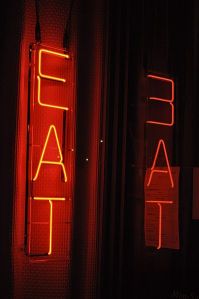 Your body just doesn’t work as well when you’re hungry or dehydrated (even slightly). Mentally, you can become slow or foggy. Emotionally, it can be difficult to keep things in perspective. And spiritually…well, it worked for Mahatma Gandhi, but chances are that starvation won’t work for you when you put on your jodhpurs.
Eat, drink and be merry. It works for holiday parties and it works for riders in the saddle, all year long.
I know it works for me. I eat often. Not a lot but a lot of times a day (at least four). I like to graze so much, I might be a reincarnated herbivore, a horse perhaps (those who live in the land of jodhpurs understand, I’m sure).
23 Sunday Dec 2012
Posted in Sunday Photos

The Wroblewski children and a rocking horse, 1924
17 Monday Dec 2012
Posted in Inspiration, Training
When I was growing up, it wasn’t unusual to hear someone say, “It’s a woman’s prerogative to change her mind.”
This now-archaic truism with its almost archaic noun still has value — especially if you include men and children. It’s okay to change your mind. And riders need to remember that.
It’s hard for riders to change their points of view and habits, in part because it takes so long to develop those habits, and so long to learn enough about horses to even have a point of view.
We seldom question the first things we learn about horses or equitation but we have yet to call those ideas our own. Later, we search out trainers and instructors, mentors, gurus, leaders and experts, and readily adopt their points of view, calling them our own. Eventually, the time comes to evaluate, with the courage to question and the wisdom to reassess our beliefs.

“Know thyself”
The thinking rider can — and should — challenge himself to welcoming new perspectives and new techniques. If you do, you’re among good company.
Philippe Karl, for instance. New copies of his book Long Reining: The Saumur Method are now being sold on Amazon for $413.22, and used copies are being offered from $125 to $900. Why such high prices? I have it on good authority that the reason is that Philippe Karl changed his mind about long reining. He won’t authorize a reprint of the book because he no longer believes in this method of training, despite the fact that he is an expert on it.
16 Sunday Dec 2012
Posted in Sunday Photos
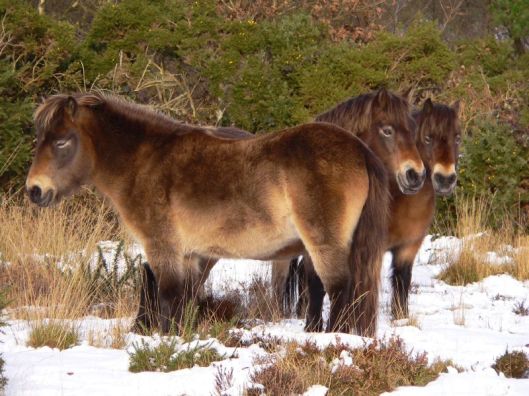
Exmoors settling their brains for a long winter’s nap
13 Thursday Dec 2012
Posted in Uncategorized
 Nominations are now open for the ESMAs — the Equestrian Social Media Awards, now in their third splendid year.
My mother would have called this shameless, but I’m going to ask anyway: would you nominate me?
If you enjoy hearing my raves and rants…what inspires me and what I think might inspire you…training tips…periodic suggestions on how you can spend even more money on your horse habit, and if you enjoy the visual feast I try to put on your plate to accompany all the words, please take a moment to nominate reflectionsonriding.com as Best Blog (#17).
The ESMAs ask that you say a few words when you do. My advice is: don’t hold back (something that’s also good to remember when you’re in the saddle). Only those nominees with unique “supporting statements” will go through to the second round of judging. Winners will be selected from among the finalists through public voting on the ESMA site (25%) and by a panel of experts (75%).
09 Sunday Dec 2012
Posted in Sunday Photos
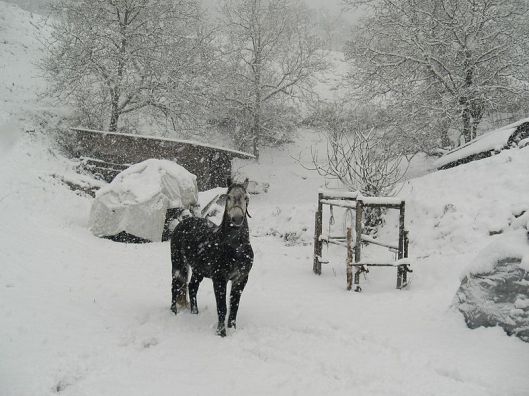
Grisaille, noun: decoration in tones of a single color, especially gray, designed to create a three-dimensional effect. First known use in 1848. From the Middle French gris (gray) and grizzle, a gray or roan animal.
08 Saturday Dec 2012
When you talk to your horse (and I expect that you do), do you think that your horse knows what you say? Do you think that it’s simply the tone of your voice that matters? Or do you think that your horse understands the words you use and their meaning?

Winter Landscape by George Morland, 1790, Yale Center for British Art
For what it’s worth, I think my horses have quite large vocabularies. And I’ve noticed that when I say something out loud, I seem to get through much more effectively than when I think something and expect my horse to read my mind. (I’ve noticed the same thing with people, especially men).
Often, when I say something out loud, I think I’m talking to myself, but when my horse overhears, it’s clear that he knows whom I’m really talking to. For example, some time ago, I kept wishing that one of my horses would relieve himself in the straw on the edges of his stall rather than in the middle of his stall, where he walked all over it and made a mess.
Night after night (because I pick stalls at night check), I would think to myself, “I wish…” One night, for no reason in particular, I said it out loud. I really thought I was talking to the air, but I did say, in a normal tone of voice, “I wish you would…” The next morning, done! All I had to do was say something. Nicely, of course.
All this comes as no surprise, I’m sure, to Masaru Emoto.
05 Wednesday Dec 2012
Posted in Language
Only in a horsey family would a conversation occur like the one I had with my sister last night.
I called to apologize for the delay in sending something to her. I verbalized my pathetic excuse, “The day ran away with me.”
“Who ran away with you?!,” my sister yelled into the phone. “Dini?”
Faithful readers of my blog will recognize the name of one of the horses I’ve had in training. Now Dini has never run away with anyone, but I think my sister just began going down the list of potential runaways with a horse whose name began with a “d.”
“No,” I said. “The day ran away with me.”
“Oh, thank God,” said my sister.
And I do, for many things, including not riding any runaways in recent memory.
04 Tuesday Dec 2012
Let it never be said that I don’t read Practical Horseman from cover to cover. That is, from front to back, just the opposite of the way we’re supposed to ride.
There it is, in tiny print, on the bottom left corner of the back cover of PH’s December 2012 issue.
 Heritage Gloves is the Official Riding Glove of The United States Equestrian Federation.
Say what?
I’m sorry, you can’t say “gloves is glove.” Official or otherwise. Heritage or otherwise. USEF or otherwise.
Why not say, “Heritage Gloves are the Official Riding Gloves of The United States Equestrian Federation?”
Or “Heritage is the Official Riding Glove of the United States Equestrian Federation?”
You just can’t say “Heritage Gloves is the Official Riding Glove of the United States Equestrian Federation.” You can’t. Unless you want to sound illiterate. And that are my final word on the subject.
Almost. Because I want to give a thumbs up to Heritage for making the best winter work glove I’ve found. It’s their Extreme Winter Glove, with a Thinsulate lining and advertised as waterproof. They are (note: not “they is”) truly waterproof.
 Reflections on Riding