
Hay there!
01 Sunday Jul 2012
Posted in Sunday Photos
01 Sunday Jul 2012
Posted in Sunday Photos
29 Friday Jun 2012
Posted in Uncategorized
I’m excited that Poland is going to have a dressage team competing at this summer’s Olympic Games, for the first time in 32 years.
Poland was in reserve to take New Zealand’s place at the Games, and was able to do so when New Zealand was unable to put together a team of three nominated horses and riders.
Katarzyna Miczarek on Ekwador, Beata Stremler on Martini and Michal Rapcewicz on Randon will represent Poland.
Best of luck to all the competitors — whether it’s medals or simply memories to take home.
25 Monday Jun 2012
Posted in Uncategorized
It’s a conundrum. Everyone hates barn drama. And everyone has experienced it — dare I say, participated in it. So if we all hate it so much, why is it so prevalent? Why do we let it go on? And what can we do about it?
Some of us have already found the solution and keep our horses at home. But what about those of us who can’t?
It’s always tempting for women to try to solve things by talking. Or by shutting down completely and pointedly not talking. The resulting silence is most often accompanied by fantasies of what would be said if women were, in fact, talking. I think it’s those fantasy conversations more than anything that leads to the problem in the first place. “I know she’s thinking this,” or “She said this, but she means that,” or “I could tell when she was looking for her martingale, that she really just didn’t want to talk to me.”
This is for those of you who participate in turning the pitchfork and heating up the muck.

24 Sunday Jun 2012
Posted in Sunday Photos

21 Thursday Jun 2012
Posted in Farm Life
From the folks that brought you duct tape and Saran Wrap as a solution to biochemical warfare — The Department of Homeland Security — we have another inspiredly idiotic idea. It really is time for Dr. Strangelove Returns.
The plan is to move the National Bio- and Agro-Defense Facility (NBAF) from Plum Island, a barrier island off the coast of Long Island, NY — its home for the last 60 years — to Manhattan, Kansas.
The mission statement of the Plum Island Disease Center reads: “We work to protect farm animals, farmers and ranchers, the nation’s farm economy and export markets…and your food supply.”
Plum Island was managed by the US Army and the US Department of Agriculture (USDA) until its management was taken over by Homeland Security in 2003. It operates under very close cover. The only access on and off Plum Island is via government ferry supervised by armed guards. The USDA proudly claims Plum Island as “America’s first line of defense against foreign animal diseases.”
No one really knows what goes on at Plum Island (except maybe the people who work there). We do know that it’s the place where the connection between West Nile Virus and dead horses was made. It’s designated as a biosafety level 5 facility. The Island has no wildlife. But the freezers have polio and Rift Valley Fever. The deer that swim onto the island are killed.
When the facility moves to Kansas, it will be a biosafety level 4 (BSL4) laboratory. That’s even more dangerous, but there are no plans to kill the million and a half cows that live in Kansas.
20 Wednesday Jun 2012
Posted in Uncategorized
The US Dressage Team heading for the Olympics has some of my favorite riders (and horses) on it, and I couldn’t be happier.
I wish I’d had a chance to watch all the rides that got them there, but the horses (the ones under my own care) come first.
Still, I’m especially thrilled for Tina, since she’s finally where she belongs. If you’d like to read more about her, check out these prior posts: Something different and The happy athlete.
I’ve talked about Steffen a few times before as well, in The seat, Core, Agree to disagree, Rules — a double-edged sword, and Notes & Quotes from a clinic junkie.
Tina and Steffen appear together in my post entitled BNT syndrome. I can’t wait till they’re together in London.
19 Tuesday Jun 2012
Posted in Uncategorized
18 Monday Jun 2012
Posted in Uncategorized
When you’re looking at a horse to buy, it’s good to know what you can fix. That’s very different from knowing what’s fixable.
The important question is: What can you fix?
To answer the question, you should consider your own abilities and dedication and the three categories of horse fixes: physical, training, and state-of-mind.
Physical fixes: Your vet is your guide to physical issues that could be of concern, which you might notice when you look at a horse or which might come up during a pre-purchase exam (PPE).
If a physical issue is fixable but you can’t afford to fix it…if a physical issue might be fixable but you can’t live with the outcome if the fix doesn’t work…or if spending money trying to fix a physical issue will affect your ability to buy another horse, then it’s best to pass on the horse. If the issue comes up after your PPE, there’s nothing you can do but cry in your oatmeal about your diminished horse budget after you pay your vet bill. When your tears are dry, you can be thankful you paid for that PPE (and those radiographs).
Skinny is easy to fix. So is a dull coat or rain rot. You can build muscle but you can’t necessarily repair muscle wastage. Sometimes chiropractic or massage work can fix stiffness or crookedness or pain, and it can be helpful to ask for a consultation from your chiropractor or massage therapist before you put Dobbin on your trailer.
17 Sunday Jun 2012
Posted in Sunday Photos
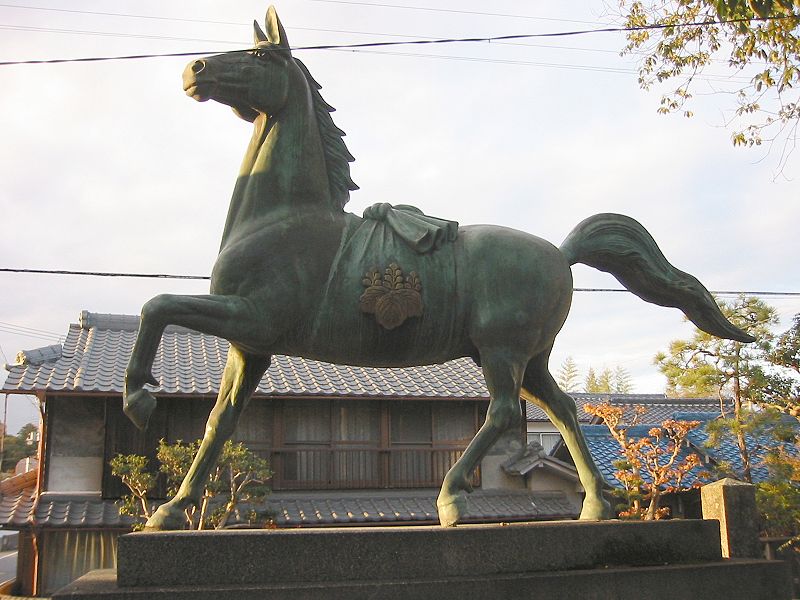
Amatsu Shrine, photograph by Jnn
16 Saturday Jun 2012
Posted in The Why?! Files
Why does my retired Thoroughbred only get hives on a Friday or Saturday night?
 Reflections on Riding