
Role models
17 Saturday Mar 2012
Posted in Inspiration
17 Saturday Mar 2012
Posted in Inspiration
16 Friday Mar 2012
That’s the theme of Natalie Keller Reinert’s blog Retired Racehorse. Natalie is a celebrated author (you can read an excerpt of her book “The Head and Not the Heart” on her blog). While you’re there, you can also see that she’s got tons of goodies, not the least of which are the thoughts she shares on training and her insights into life at the track.
The lead story on Natalie’s blog today is called Riding Hot Thoroughbreds and I’m her “guest blogger” of the day. As some of my readers know, Thoroughbreds are dear to my heart. You can see one of my own on Natalie’s blog, in “before and after” photos. I’ve also included my top ten tips for riding hot horses (who don’t have to be Thoroughbreds, although that’s always a great choice).
16 Friday Mar 2012
Posted in Racing
Back in January, I wrote a review of the HBO series Luck. It included a mini rant on the frustrations of watching television shows and movies when you can’t understand what the characters are saying…not because of their vocabulary but because of their e-nun-ci-a-tion. For weeks thereafter, I got hits on my blog when people googled the search terms “unintelligible dialog.” Really. No joke.
The news just broke that HBO is now going to cancel the series, following the deaths of three racehorses during production. The circumstances surrounding the first two deaths are shrouded in mystery, as they say, but the third horse was euthanized after rearing and flipping over. Without knowing more, I have to chalk it up to bad luck.
As sad as it is, there’s something poignant in art imitating nature and having nature exact its revenge, to which art must submit. I’m only putting this language in here in honor of David Milch, who would understand. He can use it if he wants in his next project. He’s got a first look deal with HBO that includes works from Faulkner. How perfect is that? Summer’s coming up, so you can enjoy your own festival of unintelligible dialog in A Summer of Faulkner: As I Lay Dying/The Sound and the Fury/Light in August, from Oprah’s Book Club (go, Oprah!). After reading it, you realize that the concept of “inside leg to outside rein” is actually pretty straightforward, in contrast.
15 Thursday Mar 2012
Posted in Uncategorized
Sometimes, as a trainer, I find it difficult to pull off the balancing act that is part of my daily life.
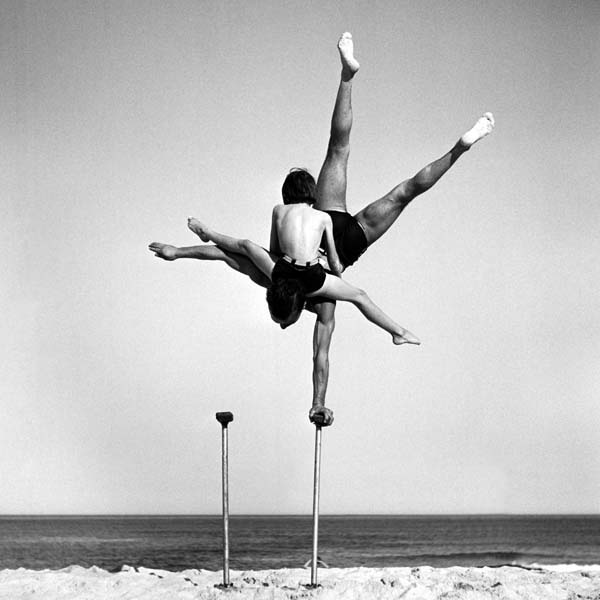
Arthur and Pauline Coutts captured by George Caddy, 1939
I can give a horse or a rider the best I have to offer in the hour or so that I work with them. I can be available by email or phone to answer questions or give support or provide suggestions. But I’m just one influence among many and I have no control over what happens outside my watch.
Most of the time, I’m fine with that. Other times, it’s harder. If I think a rider or a horse is in danger, I will always say something. But as an independent trainer, I often find myself a guest in other people’s barns alongside other people’s students and it’s part of my business to know what’s my business and what isn’t my business.
14 Wednesday Mar 2012
Posted in Uncategorized
13 Tuesday Mar 2012
Posted in Uncategorized
In Fritz Lang’s 1953 film noir The Big Heat, gangster’s moll Gloria Grahame tells widow-of-crooked-cop Jeannette Nolan, “we’re sisters under the mink.”
I think that’s kind of what Ann Romney is telling us. We’re sisters in the saddle.
It doesn’t matter that she doesn’t think of herself as wealthy, despite a net worth north of $250 million. As she says, “it could be gone tomorrow.”
As Gloria Grahame also says in The Big Heat, “I’ve been rich and I’ve been poor. Believe me, rich is better!”
Whether you think of Ms. Romney as out of touch or on a higher spiritual plane, one thing is clear: she loves to ride and she understands that when it comes to healing, there’s nothing better than a horse to cure what ails you. As a breast cancer survivor diagnosed with MS more than a decade ago, she made a wise decision to return to horses after many years out of the saddle.
12 Monday Mar 2012
Posted in Horse Care
Animal health company Merial has put together a website and notification system to help protect your horse from infectious diseases.
 If you want to see outbreak and disease information in your area, you can simply go to www.outbreak-alert.com and enter your zipcode. When I enter mine, I can see more than one rabies outbreak near me, as well as West Nile Virus in mosquitoes and animals, and endemic Eastern equine encephalitis.
Current information is compiled by gathering data from reputable sources, including the USDA, veterinarians and departments of agriculture. Veterinarians as well as horse owners are invited to contribute reports of disease events. You can read recent news relating to diseases that can affect your horse.
 You can also sign up for Outbreak Alerts simply by entering your mobile phone number or email address on the site.
On the site, just for fun (if this is your idea of fun), you can also take a quiz about the major equine diseases. I did. I breezed through the first four questions, and then blew it when I got to the question, “How far can droplets from a horse’s cough travel?” All told, I got only six out of the nine questions correct, missing one on Potomac Horse Fever, one on rabies, and another one on equine disease in general. How embarrasing! But now I know better.
11 Sunday Mar 2012
Posted in Racing, Sunday Photos
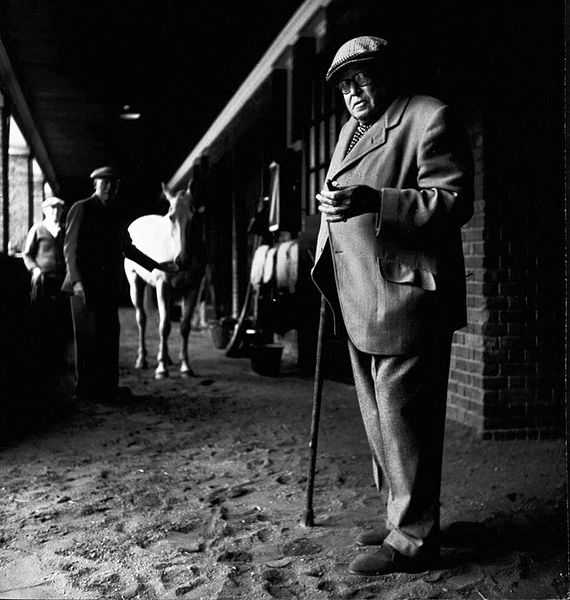
F. Ambrose Clark, heir to the Singer Sewing Machine fortune, was born in 1881 and happiest on a horse. He was reported to be a “skillful and daring” amateur steeplechase rider. He played polo and served as MFH of the Meadow Brook Hounds on Long Island. After he could no longer ride due to his injuries, he was most often seen driving four in hand.
At the time this photograph by Toni Frissell was published in Vogue (1953), he was best known as a breeder. His first wife was also a breeder, and maintained her own stable. After her death, he purchased several horses in the dispersal sale. His scrapbooks are housed in the National Sporting Library in Middleburg.
In this portrait, he stands in what looks like suede shoes in the dirt aisle of a stable on his farm in Old Westbury, Long Island, New York. Six hundred four acres of that estate now serve as the Old Westbury campus of the State University of New York.
Dirt floors in the stable. Not so good for suede shoes. Something to gather in the cuffs of your trousers. But very good for horses’ legs.
10 Saturday Mar 2012
Posted in Uncategorized
 It was only days ago that I was able to find out that I have readers from all over the globe.
That makes me a pretty happy and excited blogger!
It’s no surprise that most of my readership is here in the United States, but I’m delighted to discover that my second highest readership is from France. Since French classical dressage is dear to me, and my first lessons in dressage were given to me in French, I guess we must be “speaking the same language,” as we say. C’est merveilleux ca! (c’est domage that I can’t find out how to add accents in WordPress!).
After France, it’s the UK, Canada, Ireland, the Netherlands, Germany, Australia, New Zealand, and the Russian Federation, in that order. Thank you, dank u, dankeschon, spasiba.
09 Friday Mar 2012
Posted in Training
Everyone today is a trainer. Hardly anyone is a riding instructor.
What a shame that is.
I’m both and I enjoy being both. Riding instruction is different from training, even if you’re training both horse and rider. At least, that’s how I see it.
The difference? I think we train horses. I don’t think we train people. We may teach, we may instruct, and hopefully, we’re always there coaching. I think coaching is important — because it addresses the psychological and emotional needs of the student — and it’s important not just for those who compete, but for anyone.
When I was eight years old, I took my first lessons at a “School of Horsemanship.” I had instructors. I went to the stable and not to the barn. I didn’t call my instructors by their first names. Those instructors, who all followed Gordon Wright and the U.S. Cavalry School, put me on Shetland Ponies and off-the-track Thoroughbreds and taught me how to fall off a horse. Every horse (and a lot of ponies) were expected to be able to jump 3’6″. And they did. If your horse stopped in front of a fence, you jumped it from a standstill. And learned to keep your balance in the process.
Instruction was less kindly back in the day. There was a lot of shouting and repetition, but as I recall, you never sensed boredom or resignation or contempt or the tone that my Yankee-Irish horsewhispering boyfriend calls “snippy” in any instructor’s voice, the way you so often do now.
 Reflections on Riding