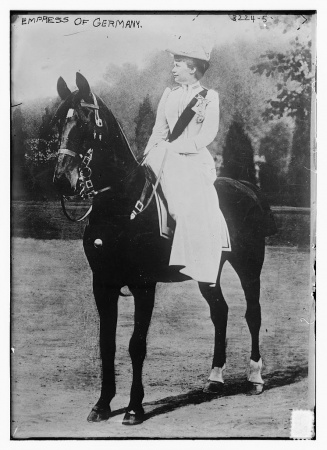
Now that's my kind of horse!
19 Sunday Feb 2012
Posted in Sunday Photos
Now that's my kind of horse!
18 Saturday Feb 2012
Posted in Uncategorized
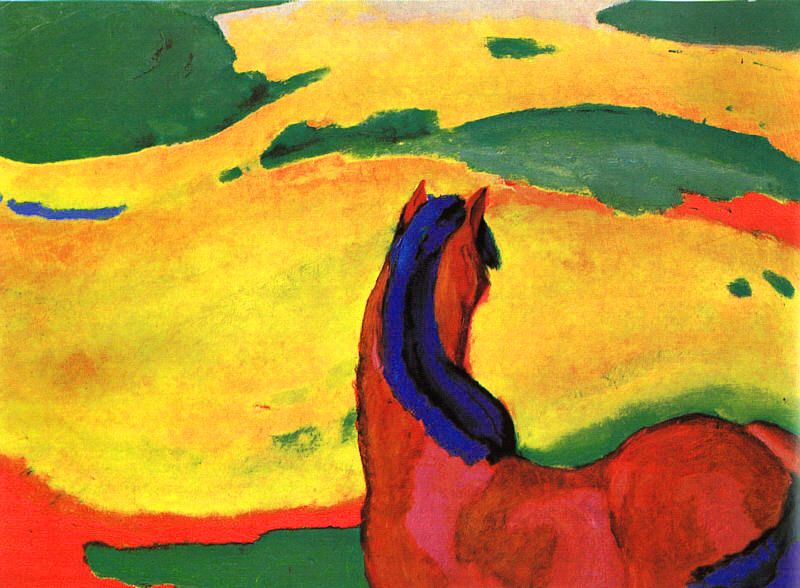
Horse in a Landscape, 1910, oil on canvas
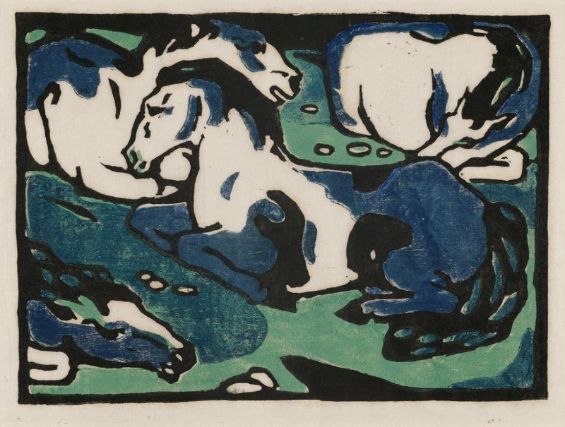
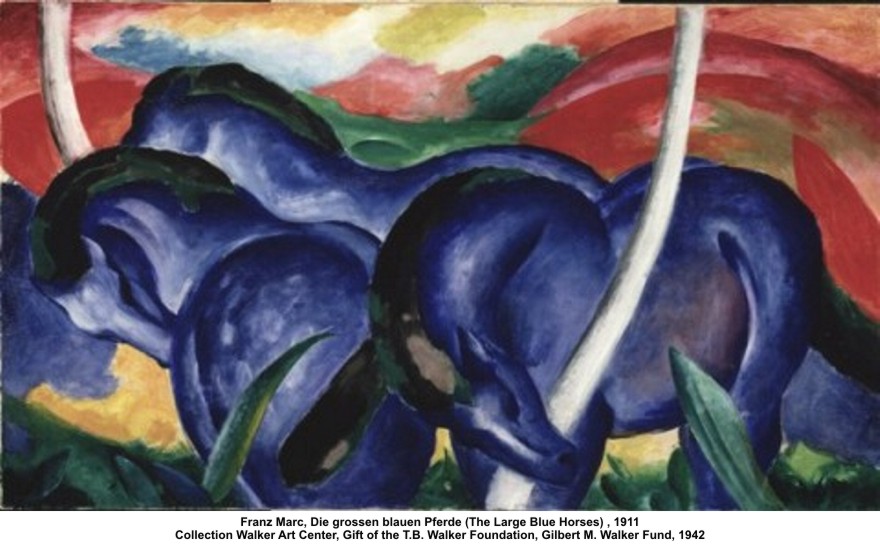
Horses Resting, color woodcut, 1911-1912, Museum of Fine Arts, Boston, MA
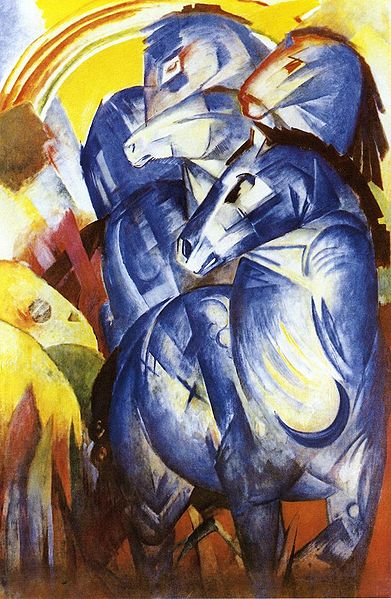
The Tower of Blue Horses, 1913, oil on canvas
It’s easy to see that Franz Marc loved horses as much as he loved creating art.
One of the leading figures in the German Expressionist movement, Marc believed in what he called the “animalization” of art. In his opinion, animals had the unique ability to represent aspects of the spirit.
Franz Marc enrolled in the Munich Art Academy in 1900, and from 1910 onwards, animals became his favorite subject matter. In 1911, along with Wassily Kandinsky, Marc co-founded Der Blaue Reiter (The Blue Rider) group, which was devoted to the cause of art which possessed a spiritual dimension.
17 Friday Feb 2012
Posted in Language, Uncategorized
I’ve been working on the accounting for my horse businesses this week, while my search for a new saddle continues, which makes me think of the Lyle Lovett song, “Which Way Does That Old Pony Run?”
It’s hard to understand what he and John Hiatt are talking about before they start strumming, but that’s okay by me (and I hope, by you too).
It’s also hard to be sure what story Lyle Lovett is singing, and about whom. I think it’s not our narrator, it’s someone else, who’s still learning, who’s asking about the pony and the saddle and the gun. And Lyle’s answer, who has gone beyond learning to knowing, is “What’s riches to you, just ain’t riches to me.” Let me know if you agree…or if you hear something different. Lyle’s not talking. He told Bob Edwards on public radio in 2001 that in this song, “the main focus was usage…was really just the language.” Which makes me wonder who asked him which way that old pony went…or whether it’s just poetry.
16 Thursday Feb 2012
Posted in Horse Care
Yesterday afternoon, one of my readers alerted me to the fact that the plan to bring back the diving horse act to Atlantic City had been abandoned by the new owners of the Steel Pier. The internet is a powerful medium for change, and a petition against the act garnered 50,000 signatures at Change.org. That’s all it took. I’m wondering whether the developers thought there were fewer animal rights activists now than there were in 1993? Have they thought about bringing back the organ grinders — just as a flyer, to see if anyone objects?
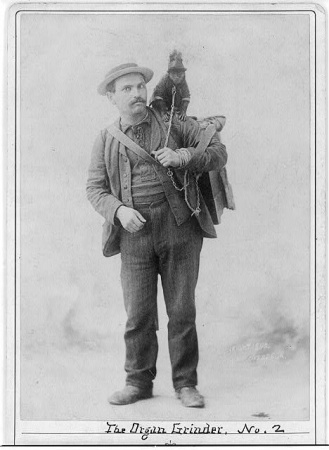
Is that a lead rope on that monkey?
So we’re stuck with racing and Rolex when it comes to extreme horse sports, at least for the time being. But wait! There’s more! How about the puissance?! And you also get…the Tevis Cup! Think about extreme horse sports now and you’ll get Grand Prix dressage!
 Do you think all those folks signing the petition against the diving horse act over at Change.org know about the battle over blood in the 20 x 60 meter arena?
There’s news there as well. It’s actually yesterday’s news, reported yesterday on eurodressage.com, which is itself reporting on yesterday’s news (actually, February 3rd’s news) regarding “the blood rule.”
15 Wednesday Feb 2012
Posted in Notes & Quotes
Klaus Balkenhol was awarded the title of “Reitmeister” (“Riding Master”) in November of last year at the CDI Stuttgart in Germany. The handsome, gray-haired gentleman said at the time, “I’m still young enough to devote myself to classical riding and the riding culture.”
I say, “Hear, hear!”
So today, let’s start by hearing a tiny bit of Mr. Balkenhol’s wisdom. This is for anyone who works with horses, regardless of their level of expertise or the experience of their horses:
“Don’t be dominant…we have to wait, so the horse can give the answer when we ask the question.”
I imagine that Mr. Balkenhol is talking about communication between horse and rider on many levels. Certainly, when we train, we must ask with our aids and wait for the horse to respond. If we drown out the response with aids that never release, how will we know that the horse has responded to our aids….or the fact that we refuse to release them?
On a deeper level, I suspect that Mr. Balkenhol is speaking of the partnership between horse and rider. As a partner, the horse must be allowed to have a voice. And we must respect the horse, by asking questions and having the patience required to wait for the answer.
14 Tuesday Feb 2012
Posted in Uncategorized
13 Monday Feb 2012
Posted in Training
Confidence has long been a cornerstone as well as a primary goal of my teaching and training. It informs what I do on the ground and on horseback and it’s what I try to give my students and their horses when I work with them.
I think it’s of equal importance for horses and riders and that’s true whether they simply want to enjoy each other’s company or progress together towards higher achievements. Nothing — not even a near-perfect position, and I’m a stickler for position — gets riders and horses further along, more quickly, than confidence.
Who knew this better than Alexis L’Hotte, whose famous guiding principle for training horses is “Calm, forward and straight?”
Calm is based on confidence (which L’Hotte likely took as a given where riders were concerned).
The manner in which horses gain confidence may vary slightly from horse to horse. There are outliers, for sure. Some horses need a supremely strong leader — certainly “alpha” mares, stallions and those geldings who, were it not for the knife, would have themselves led a herd…
12 Sunday Feb 2012
Posted in Uncategorized
Today marks 5000 hits and counting on the blog. That’s not a lot to some people (my ex is well over a quarter million on his and a friend gets over 10,000 hits a day but they’re busy talking about finance/economics). Nevertheless, my meager 5000 is a milestone for me (it’s not half pass but it is a square halt). Time for a happy dance.
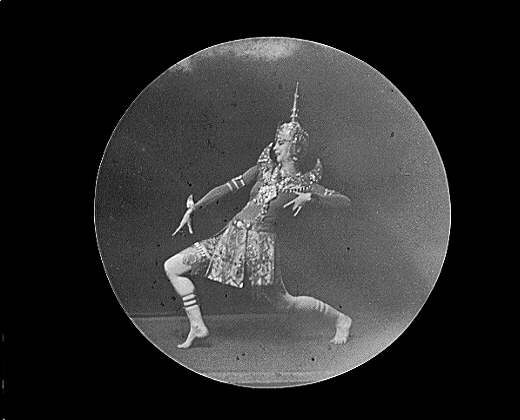
Ruth St. Dennis captured by Arnold Genthe, 1919
12 Sunday Feb 2012
Posted in Sunday Photos
11 Saturday Feb 2012
Posted in Uncategorized
In 1929, Bessie Smith sang this song:
In the year Ms. Smith recorded that song, one out of four American families bought a car. When the Great Depression hit, some of those cars ended up being towed by horses. They called them “Hoover wagons.”
People who couldn’t afford a car could afford a horse if they were lucky.
And then, when things kept getting worse, most of them couldn’t. There wasn’t a penny in their pockets. Options had run out and hope wasn’t far behind.
What happened to all those horses when there wasn’t a penny to feed them?
 Reflections on Riding