How to catch a horse

Tengo permiso de Bryant y Faye

My darling ex-husband used to say of courtship, “the woman chases the man until he catches her.”

A similar thing can be said of catching horses.  In order to be caught, a horse has to feel as if he’s not being caught.  A +/- 1000 lb. animal gets to make the choice of being caught or not being caught.  We may think that we can make that choice for the horse, but we can only successfully persuade.

It helps if the horse has been successfully persuaded from an early age so that the choice we want the horse to make has become an unconscious habit. This is often what we rely upon when we catch our horses (or lead them or ride them, or when horses agree to the myriad of things we ask them to do for us or with us).

Nevertheless, for some horses, and for some horses in some environments and at some times, whether to be caught or not remains a conscious choice, and that’s when our catching skills are put to the test.  A horse that’s escaped…a horse that’s in a large field of grass…a horse that’s with his friends and doesn’t want to be the first to leave…a horse that’s running from flies…an unsure horse with a brand-new handler…or a horse that’s panicked.

Continue reading

Peek past the Preakness

The annual Omey Race (this one in 2008) on Omey Strand in Claddaghduff, Connemara, Ireland. Photograph by Julian Matz.

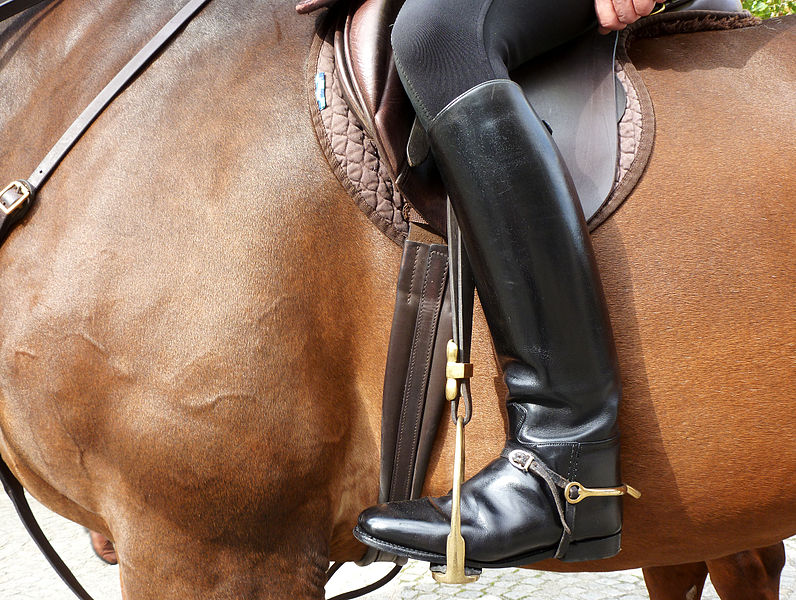
Long leathers don’t equal long legs

Photo by Oxfordian Kissuth

If you have a classic “rider’s body,” you’re blessed.  Not all of us do.  I’m one of the non-blessed.  From the top of my head to my toes, I measure 5’1″.  Even if I had long legs for my size (which I don’t), I’d still have short legs.

And my legs will remain short no matter how long I make my stirrup leathers.

Because long leathers won’t, in fact, make anyone’s legs any longer.  They may make them look longer (to someone who can’t see much) but they won’t make them longer.  Leathers that are too long will, however, make anyone’s leg less functional, regardless of its length.

Unfortunately, all too many trainer/instructors insist on lengthening stirrups for shorter riders in the misguided belief that longer leathers equal longer legs.  Not only don’t longer leathers give you longer legs, longer leathers don’t make it easier to ride.  Just the opposite.  And that’s why the top riders don’t do it (more on that later).

How do you know how long your stirrups should be?  Well, there’s the classic “just above,” “just at” or “just below” the ankle bone when your leg is hanging next to the iron tangential to your ankle.  That’s not bad for giving you an approximation.  But exactly where you should buckle your leathers is dependent on more than that.

Continue reading

Don’t do this at home

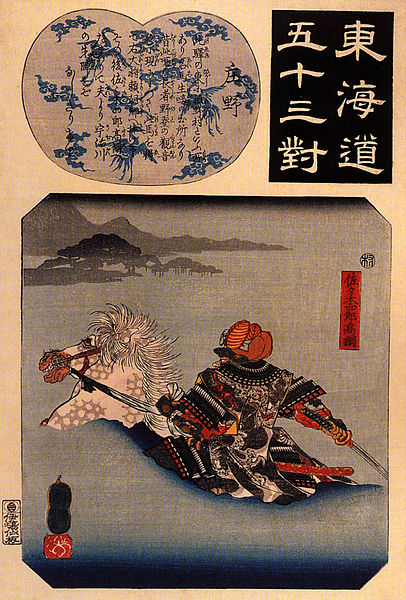
Shono-Sasaki Takatsuna fording the Uji river by Utagawa Kuniyoshi (1798-1861)

When I say “don’t do this at home,” I’m not talking about taking your horse for a swim. I’m talking about what else is going on in this work of art…

Continue reading

How to spend your money – art at auction

Bonhams’ Fine Furniture, Silver & Decorative Arts auction (also called the Continental and Decorative Arts Auction, just to make it more confusing) on May 22nd in New York has a few equestrian treasures.

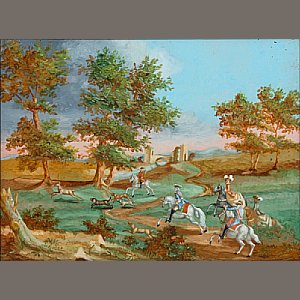
I’m in love with this piece from the collection of Edward Zajac, one of the namesakes (along with Richard Callahan) of the New York firm Zajac and Callahan and among the most brilliant decorators of the 20th century:

A French eglomise [reverse on glass] painted scene, late 19th/early 20th century, sight 9″ x 11 3/4″ estimate $600-$900. Lot #1463

Continue reading

Soak

The problem with living in the present is that it’s easy to forget what we promised to do in the past.  On October 16, 2011, for example.  That’s the date on which I told you in this post that I thought it was important for people and horses to let things soak, and that I’d expand on the topic later.

Seven months certainly qualifies as later…and I want to apologize for having taken so long.  If you’re one of my faithful readers, you know that I’ve had other things on my mind…

This week, the new horse and a hose reminded me to revisit the concept of “soaking.” Lest you misunderstand, the water involved has nothing at all to do with the concept of soaking.  That’s just a coincidence.

I first came across the word “soak” in Roger and Joanna Day’s book The Fearless Horse, and when I did, I stopped saying things like, “Let it sink in” or “Give her a minute or two.”  It was interesting to hear Buck Brannaman use the same word and employ the same concept.

Rather than speak of it in the abstract, let me share with you how soaking helped me bathe the new horse.  As I’ve mentioned before, he’s one of the bravest horses I’ve ever met, but he’s afraid of being sprayed with water. My guess is that at some point in the past, the water was too cold, he was scolded or punished in the process, or he didn’t have time to figure out what was happening and became overwhelmed.

Continue reading

Shades

Those are some cool blinkers on that horse fly, don’t you think?

I just thought I should post this before I think that I never want to see a horsefly again.

Inspiration from the Century Club

The Dressage Foundation’s Century Club just welcomed its 100th member. How perfect is that?

For those unfamiliar with the Century Club, it honors horse-and-rider pairs competing at dressage, who have a combined age of 100 years.

Of course, if you do the math, the burden of achievement does fall on the human, but it gives you something to aspire to (yes, you have another thing to aspire to).

You can cheat, of course, by buying an older horse.  And for horses — especially older schoolmasters or mistresses — how perfect is that?

If that’s not in your plan, but you still want to make it to the Century Club ranks and you’re not too green yourself, have you considered an an eleven-to-fourteen-year-old horse…or a ten-year track veteran?  Given how tough track life is and how far young horses are pushed these days, if you find a horse fitting those criteria that’s sound of mind and body, there’s a good chance that he’ll be able to be a wonderful comrade for a long time.  If you’re bargain-hunting, the prices go way down as you go further out the bell curve (schoolmasters notwithstanding) and dare I say it — how perfect is that?

Continue reading