Agree to disagree

If you’re like me, every horse you’ve ever met has taught you something. Maybe it’s just a little something.  Maybe it’s a lot.  And maybe that next horse simply confirms that you’re doing things correctly.

At least for that moment in time.  

Because it takes a lifetime to learn almost everything there is to know about horses.  You’ll never know it all.  And, if you’re like me, you’ll change your mind more than once along the way.  Maybe someone will show you a new technique…or you’ll discover that the “way that always works” suddenly doesn’t work with that one horse…or your own skills become proficient enough that you realize it’s not the method that was wrong, but your own technique.

One of the critical skills of the horseman is to have an open mind.  An open mind, along with patience and humility, will get you far.

How many of us have learned the lunging dogma that one must stand in the middle of the circle while lunging, as soon as the horse understands the lunging circle?  Yet, if you watch Philippe Karl’s DVD Classical Dressage 1, The School of the Aids, he will tell you not to plant yourself in one place, because you will bore your horse…
Continue reading

SOPA and PIPA dropped…for now

Thanks to everyone, here and abroad, who participated along with me in the protest against these bills that threatened our freedom of speech on the Internet.

Want to see the stats on the protest?  Here they are.

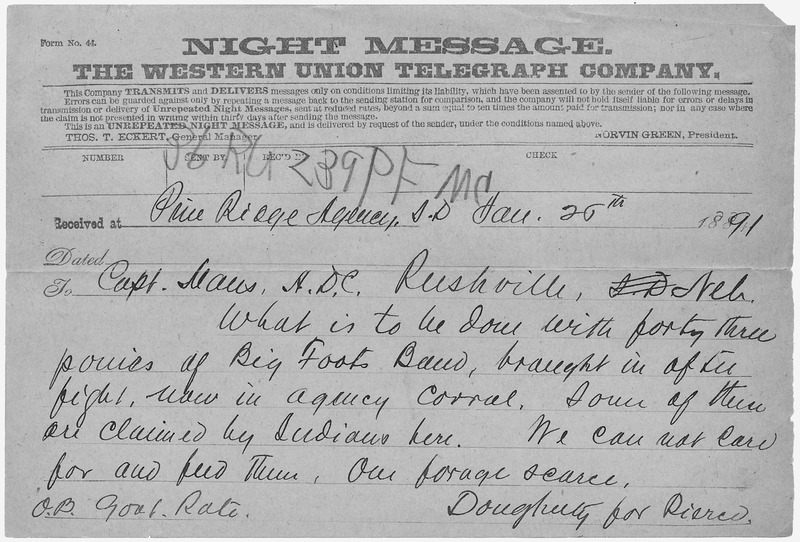
The ponies of Wounded Knee

This “night message” was sent 121 years ago on this day, following the massacre at Wounded Knee in South Dakota.  Sioux Chief Big Foot was killed in the slaughter that marked the last great conflict in the Native American wars.

This eyewitness account appears in the book Black Elk Speaks (1932):

“I did not know then how much was ended. When I look back now from this high hill of my old age, I can still see the butchered women and children lying heaped and scattered all along the crooked gulch as plain as when I saw them with eyes young. And I can see that something else died there in the bloody mud, and was buried in the blizzard. A people’s dream died there. It was a beautiful dream . . . . the nation’s hoop is broken and scattered. There is no center any longer, and the sacred tree is dead.” 

But what of the ponies?

Continue reading

Communication

Horse and Rider by Leonardo da Vinci, work on paper with silverpoint

This portrait of man and horse is one of the first works to reveal Leonardo da Vinci’s interest in the horse.  It was a preparatory study for his Adoration of the Magi, housed in the Uffizi Museum in Florence, Italy.  The work was created in silverpoint, a technique in which the artist uses a silver-pointed instrument on paper that has been prepared with a coating of powdered bone or zinc white, realizing a fine and indelible line of metal fragments.

Continue reading

Horses talk to Tilda Swinton

And when she listened, she won.  Click this link to hear her talking about it to Jay Leno on The Tonight Show.

I loved Tilda Swinton in Michael Clayton.   Seeing the horses at the end of the movie surprised me, and I’ve debated with others about their significance.  I even borrowed the screenplay from a friend in the film business, hoping that it might enlighten me (it didn’t).  If you’ve seen the movie, what do you think?

Books

Following up on yesterday’s post about reading, I thought it would be helpful to me and possibly useful for you to find out what books I’ve been busy recommending and referring to in my blog.

So I started a list.  You can find it in the header, to the right of “About” and “Best of the Blog.”

It’s comprehensive as far as the blog goes, and will be updated in concert with new posts.  It’s not intended to be a “recommended reading list” and it doesn’t include many of my favorites, but I’m surprised at how many of my favorites it does contain — and how long it is already!

If you’re curious, you can find out where the books were originally referred to simply by clicking on them, which will take you to the post where they first appeared.

I’d love to hear your comments and I feel safe in saying that so will my fellow readers.  I know I’m not alone in wanting to hear what others think, what has inspired, what has illuminated and what has befuddled.

Liked any good Facebook posts lately?

The question used to be, “Read any good books lately?”

To my mind, it was a far better question.

While educators now acknowledge that reading isn’t everything, and it’s universally acknowledged that people learn in different ways (visually, verbally and through experimentation), employing youtube or Facebook as a font of knowledge is an unfortunate trend in today’s equestrian world.

Rene Descartes (1596-1650) said, “The reading of all good books is indeed like a conversation with the noblest men of past centuries who were the authors of them, nay a carefully studied conversation, in which they reveal to us none but the best of their thoughts.”

I wish we could say the same about youtube or Facebook.  But videoclips and micro-thoughts posted on microblogs simply don’t do it.  Nor can they.  Nor are they expected to….one would think.

Continue reading

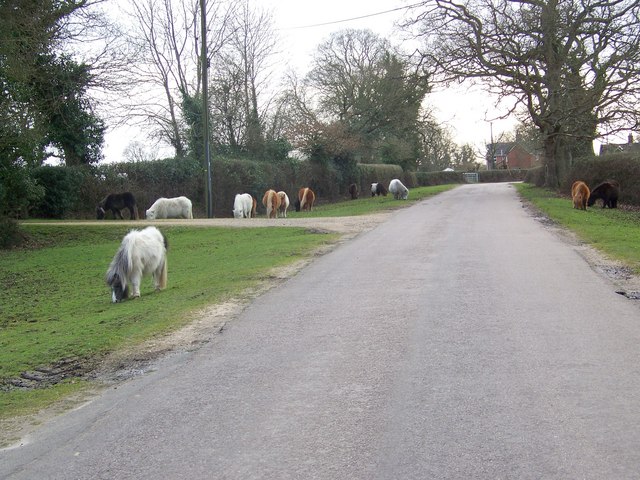
Invasion of the Shetland ponies

photo courtesy of geography.org.uk

It’s all how you look at it

successisnowhere

Tact & timing

I was just discussing flexions with one of my students today and I recalled that Jean Froissard says that in order to perform flexions well, we must have both innate and learned equestrian tact.  Who am I to disagree?  But I do. And I can get away with it, because everyone knows that for every two horsemen, there are three opinions.

I do love flexions and I love Froissard (I received his book Equitation on my 13th Christmas).  But while I think that success with horses is largely dependent on tact and timing, I’ve come to believe that nearly everyone can develop timing….and have a good shot at developing tact.

I’ve always liked this definition of equestrian tact from one of my instructors, Francois Lemaire de Ruffieu.  He says that “tact is the ability to use the right aid at the right time with the right strength and the right duration.”

Continue reading