Show me

When it comes to sales videos, here’s what I’d like to see and never do:

Conformation.  Front, back, and both sides.  I want to see the feet from the front, from the side, underneath, and I want to see the shoes if there are any.

I want to see the horse being led in hand, naked except for a halter, walking directly towards the camera and away from the camera.  I’m greedy, so I want to see the walk from the side too. Both sides, in fact.  I want to see the horse being turned in hand.

Show me how the horse is for a quick grooming.

Show me how the horse behaves while tacking up.  I want to see the bit that’s going into the horse’s mouth.  

Continue reading

I hope this isn’t Dasher or Dancer

Kieffer's reindeer saddle pad

Kieffer claims that their reindeer saddle pad is not just an “eye catcher.”  It also “supports with the treatment of abraded positions.”  Huh?  Is this translated from German to Japanese to English?

You may be wondering why a company as venerable as Kieffer would market a reindeer saddle pad (and be too cheap to hire a decent translator if their in-house copywriters didn’t learn how to speak perfect English in school, which is what I thought they all did in Europe).  Oh well, never mind, they may not be on the cutting edge of German-English translation, but I’m guessing that they’re right on the cutting edge of the news published online in the Equine Veterinary Journal.

Continue reading

Give

Those who know me, through my blog or otherwise, will probably think I’m talking about hands again.  And it’s certainly true that I say “give” quite often when I’m standing in the ring — and think it, too, when I’m in the saddle.

But that’s not the kind of giving I’m thinking about today.  I’m thinking about the giving that means helping the less fortunate on four legs.

There are a seemingly endless number of equine charities who need our help. Perhaps you know of one near you, or you have a favorite charity you’ve supported in the past.  Like you, I have my favorites:

Continue reading

How to introduce the half halt

It’s out of character for me, I know, to go right to the exercise without a long-winded exploration of what the phrase “half halt” means and if, in fact, a half halt is half a halt and if such a thing, regardless of what it is called, exists at all, along with the multitudinous ways of performing it, and why you would or wouldn’t perform it one way or another at any given time.

That gives you at least one thing to be thankful for today.

Plainly, I think of a half halt as a rebalancing.

Two Germans rebalancing c. 1547

My “cue” for rebalancing is stilling the seat.

Continue reading

Notes & quotes from a clinic junkie: Anne Kursinski

I realize that I’ve been lax in reporting on Anne Kursinski’s clinic at this year’s Equine Affaire in Massachusetts, which I promised you.

Caprilli, inventor/promotor of The Forward Seat

Anne is a fan of the forward seat — the traditional hunt seat that boasts lightness as its hallmark.  Position is primary.  As she says,

“If you can’t feel your own body, good luck feeling what your horse is doing.”

What does Anne look for in the forward seat she teaches?  Lightness and balance.  And a straight line from the rider’s elbow to the horse’s mouth.  This line continues over fences with the automatic release.

Continue reading

How to spend your money – leather care

If you’re like me, you’ve spent more money than you care to tally on leather goods related to your horse obsession. You may be a member of the “my saddle cost more than my horse” club (as I have been).  Or you may have more saddles than you have horses (as I still do, even having gotten rid of a few saddles in the last few years).

Maybe you have a nice stash of unused tack that might come in handy one day (and you’re right, it might — a well-constructed drop noseband is hard to come by these days).  Maybe you have no idea what’s even in the stash of unused tack you own.  Having just recently become reacquainted with my own stash, I know it includes a Portuguese bridle for my fantasy Lusitano as well as an assortment of white cloth girths (perhaps my most insane purchase ever).

If you’re like any normal horse person (which practically defines you as abnormal), you have more tack than you can use (or remember).  You might as well start a leather care collection, too.  Or, if you’re the frugal type (and if you are, I have no idea why you’re reading this), you can wait until you’ve used up what you’ve got and then try the items I’m going to recommend.

Continue reading

Feast

Yesterday, as I was preparing our Thanksgiving repast, my Yankee-Irish horsewhispering boyfriend commented on the feast we were going to serve the 33-year-old horse who boards with us.

He gets the same feast twice a day, after the pastures are retired for the year:  McCauley’s Longevity, McCauley’s Alam, Nutrena Empower Boost and McCauley’s (unrefined) rice bran oil, with enough hot water to make a mash.

He has some trouble chewing these days and even our best equine dentist can’t do anything to help him on that score.  But he nibbles on grass and grass hay and polishes off every leaf on the two flakes of alfalfa that he gets fed in a big tub at night, leaving a sculptural lacework of stems for us in the morning.

Continue reading

Happy Thanksgiving

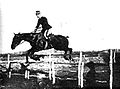
St. Louis World's Fair, 1904

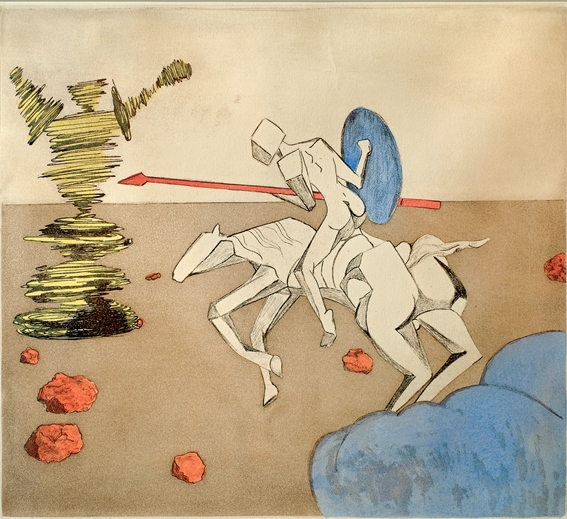
Rocinante

In case you didn’t recognize the name, that’s Don Quixote’s horse.  Certainly, the kind of horse we refer to as a “saint.”

I can only imagine that Don Quixote, the dreamer, would be feeding him more if he lived in our time.

Nevertheless, I identify with Don Quixote.  I am a dreamer too.  And most of my dreams revolve around horses.  Many of my dreams have not come true, but they have taught me lessons about patience and forgiveness and acceptance.  Lessons that help me in my work with horses, every day.

My parents had this Salvador Dali print hanging in their dining room


Continue reading