Gremlins

Office of Emergency Management, War Production Board, c. 1942-1943

Are they responsible for my last two blog posts suddenly disappearing, along with their comments?

Rebooted…no go.  I believe I can recreate the posts, but I’m contacting WordPress to see if I can return all the comments to the site.

Hope to be up and running and current again soon.

Update:  Thanks to the wiz at WordPress, everything’s back in order, including the comments!

Mind the gap – the synapse of the aids

The American Heritage Stedman’s Medical Dictionary defines synapse as “the junction across which a nerve impulse passes from an axon terminal to a neuron, a muscle cell or a gland cell.”

Interesting!” you might say (or might not), “but what on earth does that have to do with riding?

Good question!” I say.

Understanding the concept of a synapse, in structure and function, can help us understand how horses (especially green horses) process the aids.  When we understand the way in which our horses understand, we can more effectively apply our aids.

Mind the gap

When we apply an aid, there is a delay from the time we apply it to the time the horse is able to respond.  That delay — the synapse of the aids — doesn’t mean that nothing is happening.  It means only that the horse is processing our request and then coordinating his or her body to comply with that request.

Even a highly trained horse must still physically recognize our aid and translate that aid mentally into a physical reaction.  The more highly trained the horse, the smaller the synapse.  The greener the horse, the larger the synapse.

With the highly trained horse, the synapse may be so small that we don’t perceive it.  The time it takes for the impulse to travel across the synapse may be a fraction of a second.  With a green horse, it may take a second or two seconds or more.

Continue reading

How to spend your money – Teeter Hang Ups

If you have back pain, I have a recommendation that might help you.  It’s affordable and non-invasive, you can use it at home and it takes up virtually no space.

It’s the kind of thing you find out about when you need to do something about your pain…when you’re facing the unpleasant alternatives of drugs and/or surgery…when you’re ready to look at alternatives, no matter how silly they might have seemed to you before you were living with pain.

It’s an inversion table.  Did you know that a preliminary study from Newcastle Hospital in the UK concluded that patients who were told they needed sciatic operations and practiced inversion were 70.5% less likely to require surgery than those who didn’t practice inversion?

Lots of riders I know (including myself) have back issues, injuries or pain.  An inversion table is one more arrow to have in your quiver when you take aim at the annoying or painful, restricting or limiting back issues that can keep you from enjoying your horse or riding the way you’d like.

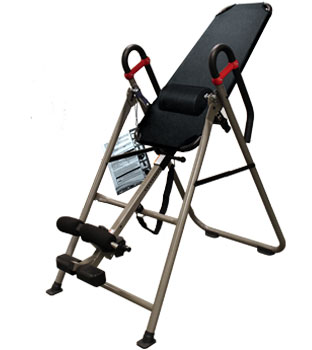
Teeter Hang Ups are wonderful inversion tables.  They’re easy to operate, safe, and you can gradually work up to full inversion.  They’re easy to clean and easy to store, and they last (there’s been one at the farm for the last seven years and it looks as good and works as well as the day we bought it).  

Here’s what one looks like:

And here’s a little story about how we discovered it:

Six or seven years ago, my Yankee-Irish horsewhispering boyfriend developed serious back pain while taking a horse down South from our farm in Connecticut.  Luckily, he was able to see a great chiropractor in Georgia while we were there, who adjusted him and recommended we get an inversion table when we got home.

We researched them, and ended up buying a Teeter Hang Ups F5000 (a now discontinued model).  My YIHB had used gravity boots years ago, and had no qualms about hanging upside down like a bat.

Continue reading

How to feel better

It’s been a busy, strenuous and, on occasion, slightly overwhelming fall so far for me.  How about you?

If you’re answering in the affirmative, I have help for you, courtesy of my niece Samantha.  If you’ve been a long-time reader of my blog, you may remember her advice in Piece of toast.

She’s back, with more practical advice, which she emailed me the other day:

“Think nice thoughts like these nice thoughts,” she told me:

Ponies eating

Ponies trotting

Ponies cantering

Ponies walking

Ponies tolting (Icelandics!)

Continue reading

Work at the walk – for the horse

A couple of months ago, I talked about work at the walk for the rider in this post.  I promised I would follow up by discussing work at the walk for the horse.  

Given the delay, I’m glad you weren’t holding your breath.

Speaking of holding your breath, you’re less likely to be holding your breath at the walk than any other gait, because of the lack of stress involved, and so is your horse, for the same reason.

That is, unless you’re working on the collected walk, prematurely or incorrectly.  As I’ve said before, there are great advantages to working at the walk for riders and horses, but it is not without its perils.  Creating a pseudo-collected walk is one of those perils.  So if you feel that your horse is behind your leg or stalling beneath you at the walk, it’s time to revisit the post I linked above, which has practical advice that can help you.

We’ve been talking about the negatives of working at the walk (that’s what happens when you start speaking of perils), but let’s move on with some positives.

The Washington Redskins cheerleaders and the Wizard Dancers performing for the troops in 2002

There, that’s better!

There are so many benefits to working at the walk for your horse:

Continue reading

Taking you for a ride

If you ever feel as if your horse is taking you for a ride, it’s nothing new, as this Ukiyo-e by Kuniyoshi Utagawa (1797-1861) shows us:

Post Olympics

It’s post-Olympics and, although I’m out of synch

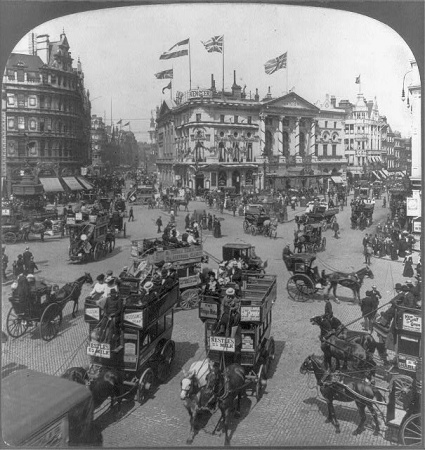
London, Picadilly Circus 1903

it’s time to post at least a few of my thoughts and impressions about the equestrian events.

I was afraid that I wasn’t going to have time to watch the Olympics at all, but I made the decision to eat into my already abbreviated sleep time to go to nbcolympics.com to catch what I could (rather than blog).  Kudos to NBC for finally giving us a way to see everything and anything we wanted to see on our computers, whenever we wanted to see it.

From the comments following last Wednesday’s post, I know that there are prominent proscratinators among my readers.  If that predilection for procrastination kept you from watching the coverage, you’re in luck.  You can still see it — and see it all — here.  I doubt whether this will be the case forever, so if you want to catch what you missed, you might want to put your proscrastinating on hold temporarily, just this once.

There sure was a lot to watch.  It took me days just to get through the eventing dressage.  And then I watched the rest of it.  I watched almost all of the dressage and almost all the show jumping.  The parts I missed weren’t at the end of the competition but rather throughout the competition, randomly and frequently.

Increasingly frequently as time went on.  Early on, I optimistically expected that disappointing rides would somehow magically improve rather than remain the same or detriorate further.  Realizing that my optimism was unfounded, as rides went on, I made the decision to use my curser to fast-forward.  That saved time, which was important because sleep deprivation is cumulative in its ill effects.

Overall, I think the horses outshined and outclassed most of their human counterparts.

Continue reading

Notes & quotes from a clinic junkie: Shannon Peters

The outside rein is an aid.  If you have to hold it, it’s not a good aid.

Search

It makes me happy that people look for answers on my blog, and I hope that they find what they’re looking for (and you do, too).

As my platform, WordPress tells me some of the search terms that people use to find me.  Some of those search terms surprise me.  Some gratify me. Some bewilder me.  And some make me laugh out loud.

Questioning horsemen on their laptops or desktops or phones or iPads, take the time to carefully choose their words and type them in the boxes in the search engines of their choice, in hopes of finding the answer they’e looking for somewhere on what used to be known as the World Wide Web.

Just yesterday, people came here wanting to know more about:

cavaletti spacing

how far up should a bit be in a horse’s mouth

pulling shoes for winter thoroughbred

bruising to bars in horse’s mouth

All great things to be thinking about.  All things that have interested me and which I’ve sought out reasons and solutions for, and which I’ve had a chance to share here on the blog.  All things that great horsemen who preceded me taught me, as did the horses I’ve been privileged to know.

I’ve learned through the last twelve months (the first anniversary of my blog is less than a week away) that lots of people want to know what Buck Brannaman has to say (245 people came here to find out)…that people want to know more about the artist Franz Marc and his extraordinary paintings of horses (“Franz Marc” is the eighth most common search term leading to my blog)…and that there’s a great interest in horse skulls.  In fact, there’s a deep and abiding interest in horse skulls, as evidenced by the following search terms and their frequency:

Continue reading