
"Doggie Driver," courtesy of Linda Broudy
23 Sunday Oct 2011
Posted in Sunday Photos
"Doggie Driver," courtesy of Linda Broudy
22 Saturday Oct 2011
Posted in Attire
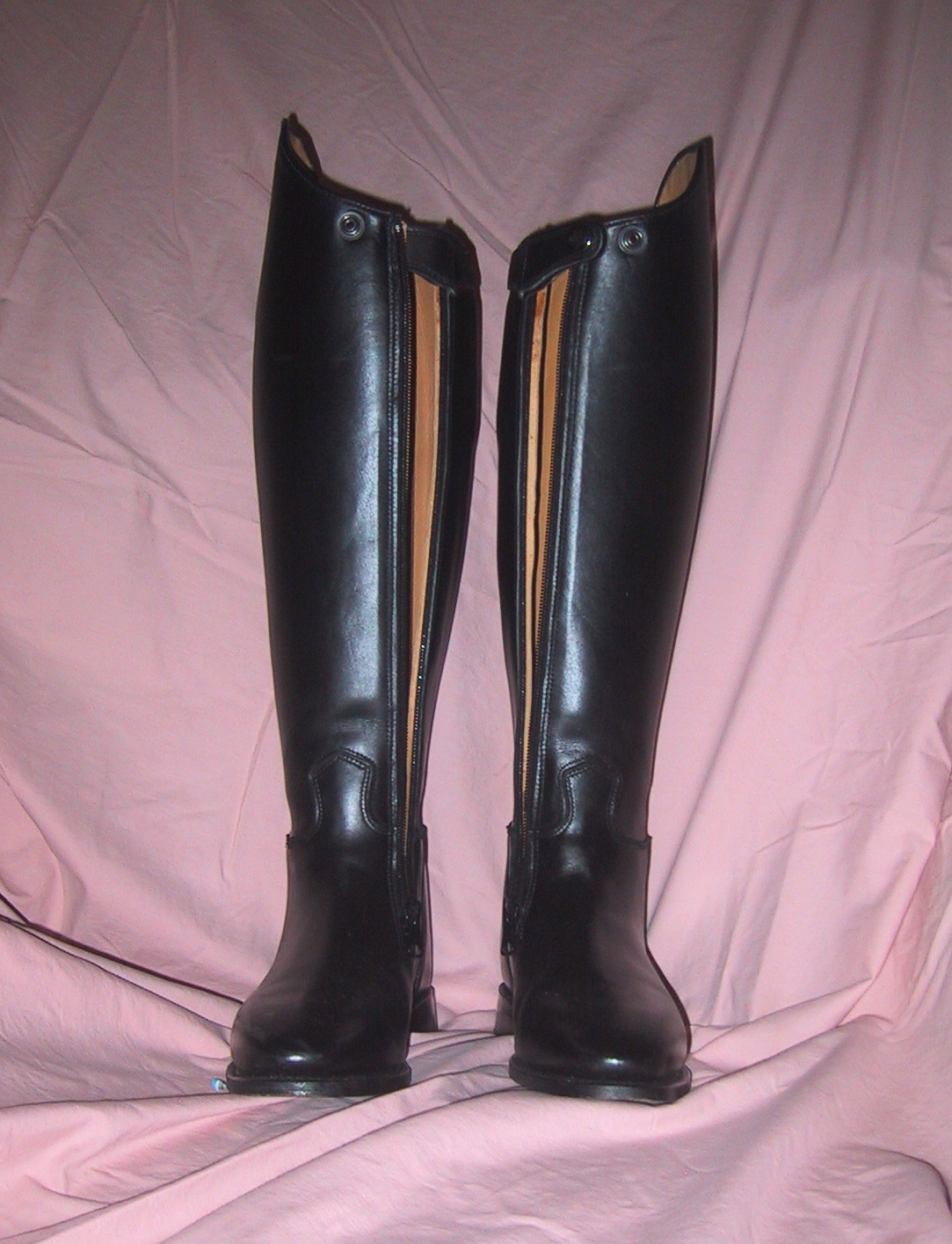 I just picked up my new custom Konig dressage boots from Beval’s in New Canaan.
The pain at the backs of my knees doesn’t keep me from feeling like this:
21 Friday Oct 2011
Posted in Uncategorized
I got back in the saddle for the first time today, after nearly 19 weeks in recovery from the fall that broke my back.
How was my back in the saddle? Fabulous, I’m happy to report!
Of course, I had a lot of help and I helped myself by setting things up for success.
I followed the advice of my Yankee-Irish horsewhispering boyfriend: The slow way is the fast way and the fast way is the slow way, a saying which loyal readers of my blog have heard before.
I picked the perfect pair to help me find out what I could and couldn’t do in the saddle — Rachel Markels Webber, longeur extraordinaire, and her vaulting horse Pico, she of the smooth and rhythmic gaits.
The biggest surprise of the day? Sitting the trot was easier than posting the trot.
20 Thursday Oct 2011
Posted in Uncategorized
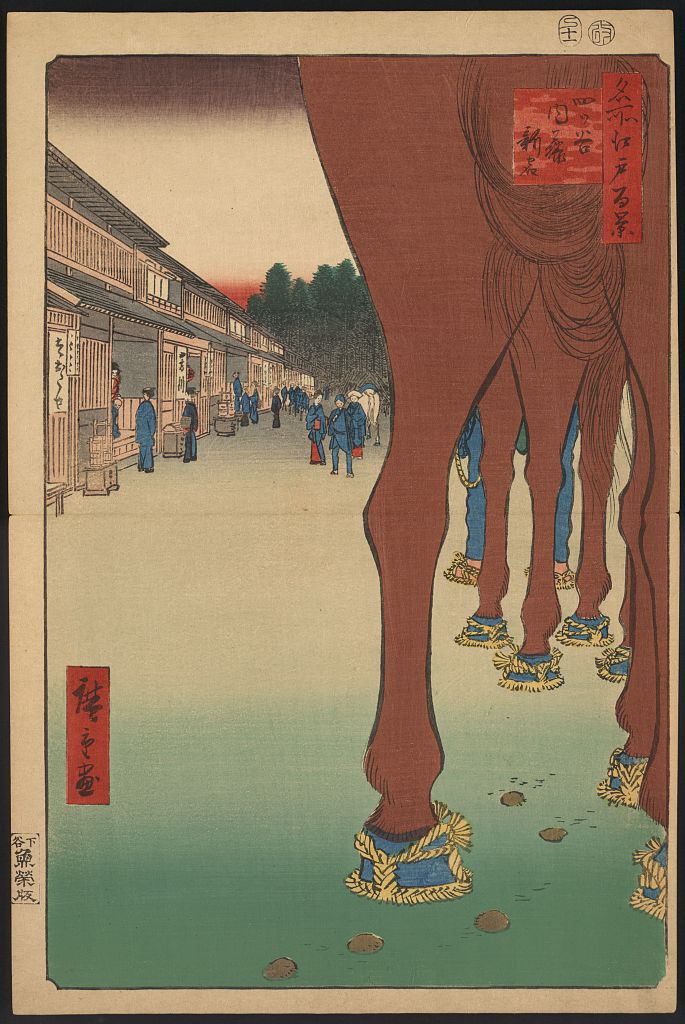
Naito Shijuku, Yotsuya, No. 86 from One Hundred Famous Views of Edo
This woodblock print in the collection of the Brooklyn Museum (but currently not on view) is fascinating on so many levels, not the least of which is its perspective.
Created in the 11th month of 1857, it depicts not only the hindquarters of the horses but also their manure. The place is Naito Shinjuku, the first stop on the main road out of Edo. The low perspective reflects the nature of the place, as Naito Shinjuku was founded in 1698 as a semiofficial center of prostitution. The girls who worked there were described as “flowers blooming in the horse droppings.”
For the horseman, perhaps the most striking aspect of this work of art is the straw wraps on the horses’ hooves. Up until the 19th century, plaited horseshoes such as these, made of rice straw, were used to protect horses’ feet. The straw slippers could be replaced as necessary. I’m sure they felt more natural to the horse than today’s boots.
19 Wednesday Oct 2011
Posted in Tack
I was at Beval’s in New Canaan yesterday and I saw a beautiful and odd-looking saddle on a saddle rack by the door. It was a Butet, but unlike any saddle I had ever seen before.
I’m a Butet fan from way back, and I’ve bought both a Butet dressage saddle (flat, brown, calfskin, close contact, light) and the hunt saddle that George Morris endorses, which I got when it was $2000 less than it is now and known as “The California.”
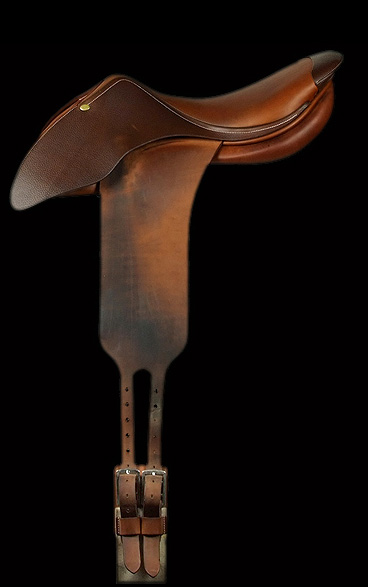 This new Butet looked like some curious cross between a trail saddle and a jumping saddle. It sat on a pad embroidered with the word “Pratique.” I had to ask what it was. Beval’s manager told me that it was a brand-new design, that she’d been to France to see it, and that they were very excited about it. It was a “Practice” saddle, designed to help riders perfect their seats. Zut alors!
If I had unlimited funds and several schoolmasters to give lessons on, I’d definitely buy this saddle. It’s even more minimal than the close-contact saddles of yesteryear with their flat seats, lack of blocks, and lack of knee rolls (just like the Crosby Equilibrium that’s in my tackroom at home).
18 Tuesday Oct 2011
Posted in Training
This morning, my Yankee-Irish horsewhispering boyfriend read me something from one of Pete Ramey‘s books while we drank our Lyons tea (“Refresh and Revive!”).
Pete suggested that before trimming, it’s important to find a place for the horse to stand where he feels comfortable…and to find that place on the horse’s body that makes his lip stick out two inches when you scratch it.
Just another way of setting up your horse for success.
While I don’t put the horse’s pleasure before my own, I think a horse that’s set up for success performs best, which consequently makes for happier horses and riders.
If you want your horse to perform well under saddle, there are lots of things you can do to set him up for success, and that starts on the ground. It starts with the mega issues like enough turnout, a balanced diet, regular veterinary care, and proper tack that fits properly. Keep your eyes open and put your hands all over your horse whenever you can, so you can catch any health issues as soon as they appear. Know your horse, and you’ll often get a sense when something isn’t right.
Then there’s under saddle. There are three things that I think are most important when setting up your horse up for success:
17 Monday Oct 2011
Posted in Uncategorized
Isn’t it great when your horse is happy to see you?
Today, I went out to the field where my young warmblood is turned out with three other geldings. He was at the far end, congregating with the others nibbling the last of the clover.
I stood near the gate, said “hello” and spoke his name. He heard me before he saw me, turned around in a half volte and straightened (good boy!), then trotted towards me, his long legs covering the length of the field in an easy, athletic stride.
16 Sunday Oct 2011
Posted in Sunday Photos
My weekends are always a strange combination of busy and relaxing. I teach and sometimes travel (fall is the time when clinic junkies get to indulge their habit). At home on the farm, there are the retired horses to tend to, and they never take the weekend off. But I also try to give myself time to “soak,” because that’s as important for people as it is for horses (more on soaking in a later blog post).
When I told my Yankee-Irish horsewhispering boyfriend, a few days ago, that I often didn’t feel like writing on the weekends, he suggested that I post a photo for my readers on Sundays. That’s why he’s so good with the horses…
It’s been an unusual fall here in Connecticut, with the foliage bursting into color seemingly spontaneously. It’s beautiful. Just like the photo below. Enjoy.

Adirondack boat house, courtesy of the photographer
15 Saturday Oct 2011
Posted in Notes & Quotes
Walter Zettl is one of those rare instructors who cares as much for horses as he does for riders. I cherish the inscription he wrote in my copy of Dressage in Harmony, from Basic to Grand Prix, wishing my horse, as well as me, luck in our journey together. That horse is no longer with me, but the journey and Herr Zettl’s good wishes remain.
Doctor of Philosophy in the Glass-Half-Full School, Herr Zettl sees the progression of the dressage horse as a continuum, without the commonly perceived (and sometimes considered impassable) hurdles between levels — even the lower levels.
How refreshing this is, as the bar keeps getting set lower and lower in terms of what is expected of the everyday horse and considered attainable by the everyday rider. This isn’t only true of dressage, it’s also true of jumping, when a horse is now considered something special when he “can do three feet.”
14 Friday Oct 2011
When was the last time you checked yours?
Without you even being aware of it, your leathers can become uneven. Your body can become uneven as a result. Continuing the chain of dominoes, your horse, feeling your lack of balance, may stop going so well for you.
It’s like that old nursery rhyme: For want of a nail, a kingdom was lost.
It’s always surprising to see how many people ride with uneven leathers. That goes for beginners on schoolies, and those schooling I-1. I have to confess, it’s caught me up, too, on more than one occasion — especially when riding one of my client’s horses, who had a brand-new saddle with brand-new leathers. I’d wonder why I felt a little skewed in the saddle and work on making my seatbones even…until I remembered to check the length of my stirrups and realized my seat was not the problem.
 Reflections on Riding