Beauties on the backstretch

There’s a place in my heart reserved for thoroughbreds.  And a little piece of my heart breaks every time I think of the thoroughbreds that won’t have a life after the track.  I wish I had a home for them all.

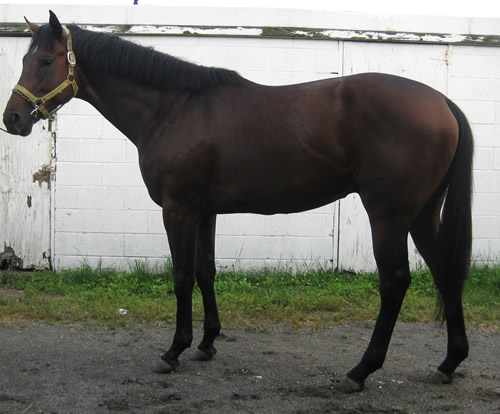
On Sunday, October 23rd, from 9am till noon, the Sixth Annual Suffolk Showcase is taking place at Boston’s Suffolk Downs, which is closing for the season on November 5th.  The good people from CANTER (The Communication Alliance to Network Thoroughbred Ex-Racehorses) will be there to introduce you to the current crop of beauties on the backstretch.

To my way of thinking, there’s nothing as beautiful as a grey thoroughbred, and Chief Picolo is a perfect example of why.  Seven years old, 17 hands, sound and gorgeous (if you’ve ever wondered what they’re talking about when they compliment a horse’s “dry hocks,” take a look at Chief’s):

Chief Picolo, $3000.

And if you’re looking for a now-and-forever husband horse, how about “Little Blow Heart?”  He’s laid back, 16.3h, 3 years old and a real “package” (how can you not love a horse that’s put together like this?): Continue reading

Dreams

Or did you want to go to the Olympics, the way I did?

Politics

You may remember my friend the natural horsemanship trainer from this post.  For this friend of mine, the equality between man and horse is paramount.  It’s no surprise that one of her favorite quotes is from Don Vincenzo Giobbe, c. 1700:

…and I whispered to the horse, “Trust no man in whose eye you do not see yourself reflected as an equal.”

In the politics of horsemanship, that’s democracy at its purest.

One might think that all natural horsemanship trainers, at least those known for their kindness, gentleness, respect and trust-based techniques, would see the relationship between themselves and the horse in the same light.

And yes, I know that the phrase “natural horsemanship” holds as much meaning as “natural flavoring” — the chemical concoction remotely derived from something natural, but still made artificially.  Nevertheless, it’s generally acknowledged that Buck Brannaman is the real deal.

Continue reading

An exercise for better corners

While I admire the Dixon Oval at Devon, there’s nothing like a corner for teaching a horse.

It’s a place where you can help a horse learn to bend, learn to engage the inside hind leg, learn to maintain rhythm and tempo and impulsion, and learn balance.

It’s a place where riders can learn about the outside rein, the sometimes forgotten indirect rein, their own straightness, timing and feel.

It’s a place where horses can learn how to coordinate their front and hind ends and where riders can learn to coordinate their aids, and ride the hind end of their horses.

It’s a place where the holes in your horse’s training — or your riding — really show.

As it is with shoulder-in, it takes a while for horses and riders to be able to make their best corners.  But it’s something to start working on as soon as the basics of go-whoa-turn are in place.  It’s nice to know that if you do any traditional work in hand or groundwork that involves displacing your horse’s hindquarters, you’ve already introduced corners.

Continue reading

Vote

Client Amy Goodusky has made it to the finals of eventingnation.com’s blogging contest. Congratulations Amy!

The topic for the final entries was “Money and Eventing,” with instructions specifying that the finalists include quotes in their entries.  Amy asked me to contribute my thoughts and I suggested that eventing could adopt NASCAR’s business model.  That way, the Europeans could try to figure out how to afford to compete over here, instead of vice versa.

Continue reading

Submission

In yesterday’s post, I promised you a misunderstanding for another day.  Well, another day dawns, as they say.  Or used to say.

Let me start by telling you a little (true) story.  I have a friend who is a well-known natural horsemanship trainer.  She has dealt with thousands of troubled horses and thousands of riders in search of solutions.  I suspect that she feels as strongly about language and its meaning as I do, since she readily corrected me the other day, when I referred to submission.

We were talking about a horse that hadn’t yet figured out how to make the best choices for himself (on this we both agreed) but I said it would get better for him when he learned how to submit, and she said I shouldn’t say submit; I should say accept.

Continue reading

Spoiled

For more than ten years now, a series of books have attempted to help people understand the differences in how men and women communicate. Books like the groundbreaking You Just Don’t Understand: Women and Men in Conversation by Deborah Tannen, or the perennial bestseller Men are from Mars, Women are from Venus by John Gray, or the popular GenderTalk Works: 7 Steps for Cracking the Gender Code at Work by Connie Glaser.

Too bad there’s not a book like this for horse people.  We could call it something like Pro’s and Ammies:  A Conversational Primer.  If I don’t write it, someone should, because we need a book that cracks our code.

For example, let’s take the word spoiled.

Continue reading

How to spend your money – Back on Track

I’ve done enough wrapping of horses’ legs that I can make a very attractive, would-please-Anne-Kursinski kind of wrap.  I’m helped by the fact that I use Back on Track no bows for my standing wraps.  Not only are they pretty, they’re effective.  Just like good eq.

The fact that they’re black is part of what makes them so elegant. But they’re also easy to handle, so the big concern about even tension throughout the length of the wrap becomes a smaller concern. Even novices can make nice looking wraps using the Back on Tracks no bows (you have the option of pillow wraps, too, if you prefer).

And if you have any aches and pains yourself, I have additional ways for you to spend your money:  on Back on Track stuff for yourself. If you also have a dog, go wild.

Continue reading

Sing

I sing to my horses (and sometimes to other people’s horses).  I know I’m not the only one.

My current repertoire is:

“Tea for Two” (for my retired TB of the same name):

Continue reading

Buck the Baucherist

While the definition of a Baucherist may depend on who you talk to, the most recognizable cornerstone of Baucher’s philosophy is “hand without leg and leg without hand.”

In certain circles (of folks not flatwork), the very name Baucher will stir up controversy, as it has for a hundred years or so.  That’s what happens when you make a big deal out of what you believe (Baucher’s First Method) and then change your mind later (Baucher’s Second Method).  Just ask David Stockman, the Reagan Budget Guru turned Liberal Pundit.

Continue reading